

JUST AN HOUR A WEEK IS ALL IT TAKES
Based on Thinkie's most recent data from over 100 engaged users who regularly train with Thinkie for at least one month, the results are clear: consistent cognitive training leads to measurable improvement.
Thinkie measures progress using the Brain Age test, a gamified cognitive assessment designed by Dr. Ryuta Kawashima to evaluate three core areas of cognition:
- Mental speed
- Attention
- Working memory
These components are combined into a single Brain Age score, which reflects overall cognitive efficiency. A lower Brain Age indicates faster processing speed and stronger overall cognitive performance relative to one’s actual age.

Users train for about 1 hour each week, broken into sessions of 10-15 minutes each, performed every other day. What other body part can you improve in just 1 hour a week?
To ensure accuracy, Thinkie makes the Brain Age test available in the app once per month, allowing users to track long-term progress while minimizing short-term learning effects.
What the Data Shows
The chart below shows the average change in Brain Age among these users over time.
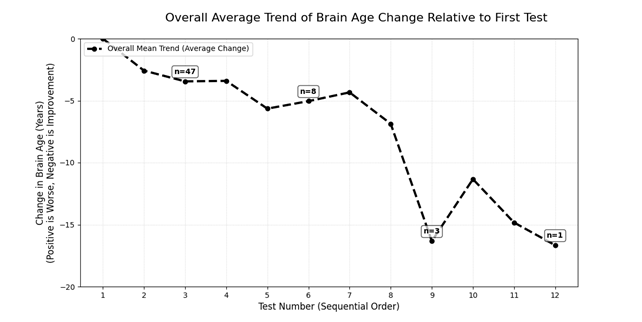
As you can see, the overall trend line slopes downward, meaning that as users continue training and tracking their Brain Age, their scores improve significantly.
This finding aligns closely with the research we conducted in Japan, further validating the efficacy of Thinkie’s approach to neurofeedback-based cognitive training.
A lower Brain Age reflects better cognitive performance and mental agility,1 and these results demonstrate that persistence truly pays off. Users who stay consistent with their Thinkie sessions experience noticeable progress as they move from their first Brain Age test to later ones.
Even if your Brain Age doesn’t decline significantly, maintaining your current level of cognitive function is already a huge win, because it indicates you’re preserving your brain health and staying mentally sharp over time.
In short: the more you train, the stronger -- and younger -- your brain becomes.
1 Brain-predicted age difference is associated with cognitive processing in later-life