
Today's leading brain training platforms offer adaptive difficulty, gamified exercises, and performance tracking that would have seemed remarkable a decade ago. For many people, downloading a cognitive training app is a sensible first step toward protecting their mental sharpness.
But there is a fundamental question those apps cannot answer: is your brain actually engaging during the training?
The question is not rhetorical. It is the central design limitation of every app-only cognitive training system, and understanding it is the key to choosing the right level of brain training for your goals.
This page lays out exactly what app-only training delivers, where its structural limits are, and what functional Near-Infrared Spectroscopy (fNIRS) neurofeedback adds to the equation. The goal is not to dismiss app-only training. It is to give you a clear picture of two genuinely different tiers of cognitive intervention, so you can make an informed decision about where you want to invest.
The core distinction: App-only platforms train cognitive behavior. Thinkie, powered by fNIRS, trains the brain itself, with real-time biological confirmation that the right neural circuits are actually firing.
What App-Only Cognitive Training Does Well
App-based brain training is accessible, affordable, and backed by a growing body of research. Let's be precise about what the evidence actually shows.
A 2025 systematic review published in JMIR mHealth and uHealth evaluated 24 cognitive training apps using the Mobile App Rating Scale (MARS) and found that most apps (79.2%) achieved an "acceptable" quality rating across engagement, functionality, aesthetics, and information credibility. The review confirms that app-based cognitive training has matured into a legitimate category of digital health intervention.
Studies show that consistent use of well-designed apps can produce measurable improvements in specific cognitive domains, including:
- Processing speed: Faster response times on trained tasks
- Working memory: Short-term improvements in digit span and similar measures
- Attention: Reduced error rates on attention-demanding exercises
- Fluid intelligence: Some gains in reasoning and problem-solving, particularly in younger populations
The Accessibility Advantage
The strongest case for app-only training is its low barrier to entry. A subscription costs a few dollars per month. There is nothing to wear, no hardware to pair, and no learning curve beyond downloading the app. For someone who has never engaged in structured cognitive exercise, an app is an excellent starting point.
This matters because cognitive training, like physical exercise, is most effective when it becomes a consistent habit. An app that someone actually uses daily delivers more value than a sophisticated system that sits unused. The best cognitive training tool is the one you will commit to.
What the Research Actually Shows
The evidence is encouraging but nuanced. A 2025 randomized controlled study published in Psychological Research (N = 103 healthy older adults) found that participants who used a brain training app for three months improved significantly on the tasks they practiced within the app. However, the researchers found no evidence that these practice effects transferred to untrained cognitive tasks assessed before and after the intervention.
This is the "transfer problem" and it is the most important limitation in the app-only research literature. Improving at a memory game does not automatically mean your working memory improves in everyday life. The brain gets better at the specific task, not necessarily at the underlying cognitive capacity.
App-based training is genuinely valuable for:
- Building a daily cognitive exercise habit
- Maintaining mental engagement and stimulation
- Tracking in-app performance trends over time
- Accessible entry-level cognitive health support
The Structural Limit: Training Without Measurement
Here is the core problem with app-only cognitive training, stated plainly: the app has no idea what your brain is doing.
When you play a memory game, the app records your score. It knows whether you tapped the right tile. What it cannot know is whether your prefrontal cortex, the brain region responsible for working memory, executive function, and higher-order thinking, was meaningfully activated during that session. Two people can achieve the same score through completely different neural strategies. One person's brain may be working hard; the other may have found a shortcut that bypasses the intended cognitive demand entirely.
This is not a flaw in any particular app. It is a structural limitation of software running on a screen with no connection to the user's biology.
The Feedback Loop Problem
Effective skill training relies on a closed feedback loop: attempt a task, receive feedback on performance, adjust, and repeat. Physical therapy works this way. Athletic coaching works this way. The most effective cognitive training should work this way too.
App-only training closes part of this loop: you attempt the task and receive a score. But the score reflects behavioral output, not neural engagement. The loop is incomplete because the feedback does not confirm whether the right brain circuits were actually recruited.
Consider the analogy of physical fitness. A step counter can tell you how many steps you took. It cannot tell you whether your cardiovascular system was challenged, whether you burned meaningful calories, or whether your training was appropriate for your fitness level. A heart rate monitor closes that gap. Without it, you are exercising blind.
App-only cognitive training is the step counter. fNIRS neurofeedback is the heart rate monitor.
Why the Transfer Problem Exists
The "transfer problem" described in the research literature, where gains on trained tasks do not transfer to real-world cognitive function, is directly connected to this measurement gap. When training is guided only by behavioral scores, the brain can learn to optimize for the score without fundamentally strengthening the underlying neural circuits.
Research published in Frontiers in Neuroscience notes that fNIRS neurofeedback targets spatially specific brain hemodynamics, meaning it trains the actual neural tissue rather than the behavioral output. This specificity is what creates the conditions for genuine transfer effects.
Key insight: App-only training optimizes for task performance. fNIRS training optimizes for neural activation. These are not the same goal, and the difference in outcomes reflects that distinction.
What fNIRS Adds: The Science of Closing the Loop
Functional Near-Infrared Spectroscopy (fNIRS) is a non-invasive brain imaging technology that measures real-time changes in blood oxygenation in the prefrontal cortex. When neurons fire, they demand oxygen. fNIRS detects that hemodynamic response, providing a direct window into brain activity as it happens.
This is not a new technology. fNIRS has been used in neuroscience research for decades and is backed by an extensive body of peer-reviewed literature. What Thinkie has done is bring this capability into a wearable, consumer-accessible form factor that works in your home.
How the Thinkie System Works
The Thinkie System consists of two components that work together:
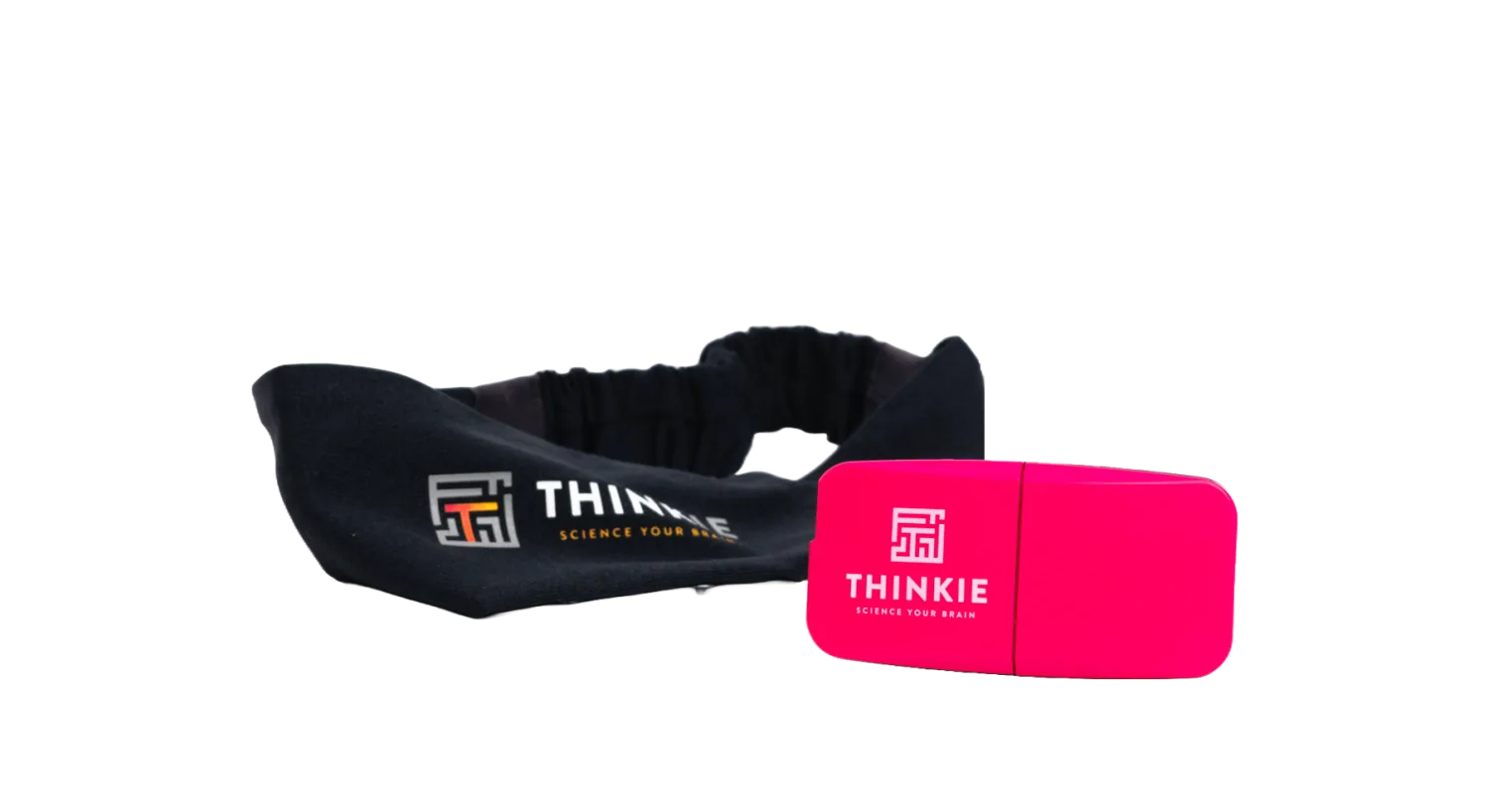
- The Thinkie Band: A lightweight wearable sensor in a cloth headband that uses fNIRS to measure prefrontal cortex blood flow in real time. It pairs wirelessly with the Thinkie app via Bluetooth.
- The Thinkie App: Neuroscientist-designed cognitive training games that adapt in difficulty based on your actual neural engagement, not just your score. The app also includes the Brain Meter, a tool that measures brain activity during any mental activity, from reading aloud to language learning to playing music.
During a training session, the Thinkie Band continuously reads your prefrontal cortex activity. The app uses that data to confirm that your brain is genuinely engaged and to calibrate the training accordingly. If your neural activity drops, the system knows. If you are in a high-engagement state, the system recognizes that too.
This is the closed feedback loop that app-only training cannot provide.
What the Research Shows About fNIRS Neurofeedback
A 2024 review published in the NIH's PMC database concluded that fNIRS offers a unique application potential; that is, "the targeted training of brain activity in real-world environments, thereby significantly expanding the scope and scalability of haemodynamic-based neurofeedback applications." The review highlights fNIRS's advantages over both fMRI and EEG, including portability, motion tolerance, and full safety for repeated long-term use.
A sham-controlled study at Maastricht University (N = 62) found that fNIRS neurofeedback training of the dorsolateral prefrontal cortex (DLPFC), the region most associated with working memory, produced measurable neural activation changes that transferred to working memory-related brain activity in the absence of feedback. In other words, the training effects persisted beyond the training session itself.
The Brain Age Evidence
Thinkie's parent research organization, NeU Corporation, has tracked real-world outcomes across thousands of users. The full data is detailed in our brain age improvement research. Key findings include:
- 3.7 years of brain age reduction on average after three months of consistent Thinkie training
- Up to 21 years of brain age reduction documented in long-term users after three years of practice
- Measurable improvements in cognitive speed, working memory, and executive function across adults from ages 40 to 90+
These outcomes reflect what happens when cognitive training is guided by actual neural feedback rather than behavioral scores alone. The brain is being trained, not just tested.
You can explore the full research behind Thinkie's approach on our science page and in our neurofeedback white paper.
Side-by-Side Comparison
The table below summarizes the key differences between app-only cognitive training and the Thinkie System. Both are legitimate approaches to cognitive health. They are not the same approach.
Who Should Start With App-Only Training
App-only training is the right starting point if:
- You are new to structured cognitive exercise and want a low-commitment entry point
- Your primary goal is maintaining engagement and mental stimulation
- Budget is a primary constraint
- You want to explore whether cognitive training fits into your routine before investing further
Who Is Ready for Thinkie
Thinkie is the right choice if:
- You want confirmation that your training is actually engaging your brain, not just your fingers
- You have been using an app-based approach and want to know whether you are making real neural progress
- You are proactively managing cognitive health and want the most evidence-backed home system available
- You are 40+ and treating brain health with the same seriousness you give physical health
- You want a system that works during any activity, not just during dedicated training sessions
The Upgrade Path: From App to fNIRS
Think of app-only cognitive training and Thinkie not as competing products but as two levels of the same commitment. Many Thinkie users started with a brain training app. The app built their habit, and Thinkie deepened the impact.
The transition is straightforward. The Thinkie app includes the same style of cognitive training games you may already be familiar with, designed by Dr. Ryuta Kawashima, the neuroscientist behind the Nintendo Brain Age series. The difference is that when you add the Thinkie Band, every session is now biologically verified, so you are not just playing a brain game; you are training your prefrontal cortex with real-time confirmation that the work is being done.
A Note on the Brain Meter
One of Thinkie's most distinctive features is that it extends beyond dedicated training sessions. The Brain Meter function lets you measure your brain's engagement during any activity: reading a book aloud, practicing a language, solving a puzzle, playing an instrument. This is something no app-only platform can offer.
This matters because the prefrontal cortex is engaged by far more than formal brain training exercises. Understanding which activities genuinely challenge your brain, and which ones feel productive but actually require minimal neural effort, is actionable cognitive health intelligence that app-based platforms simply cannot provide.
The result is a personalized cognitive health picture that goes well beyond a leaderboard score.
The Bottom Line
App-only cognitive training is a legitimate, accessible entry point into brain health. The best platforms are backed by real research, and consistent use can produce meaningful improvements in the tasks they train. If you have never engaged in structured cognitive exercise, starting with an app is a reasonable choice.
The limitation is structural, not cosmetic. Without a biological signal, app-based training operates in the dark. It cannot confirm whether your brain is engaged, cannot adjust training based on your actual neural state, and cannot close the feedback loop that research increasingly identifies as the mechanism behind real cognitive improvement.
Thinkie adds the missing layer. The fNIRS sensor turns a training session into a genuine brain workout, with biological verification that the right circuits are firing, outcomes that transfer beyond the app, and a brain age trajectory that users can actually measure over time.
If you are ready to move from training behavior to training your brain, explore the Thinkie System. The Thinkie Band is HSA/FSA eligible, ships with the full app (with purchase of Premium or Flex plans), and is backed by decades of fNIRS research and the neuroscience of Dr. Ryuta Kawashima.
Your brain deserves more than a high score.